

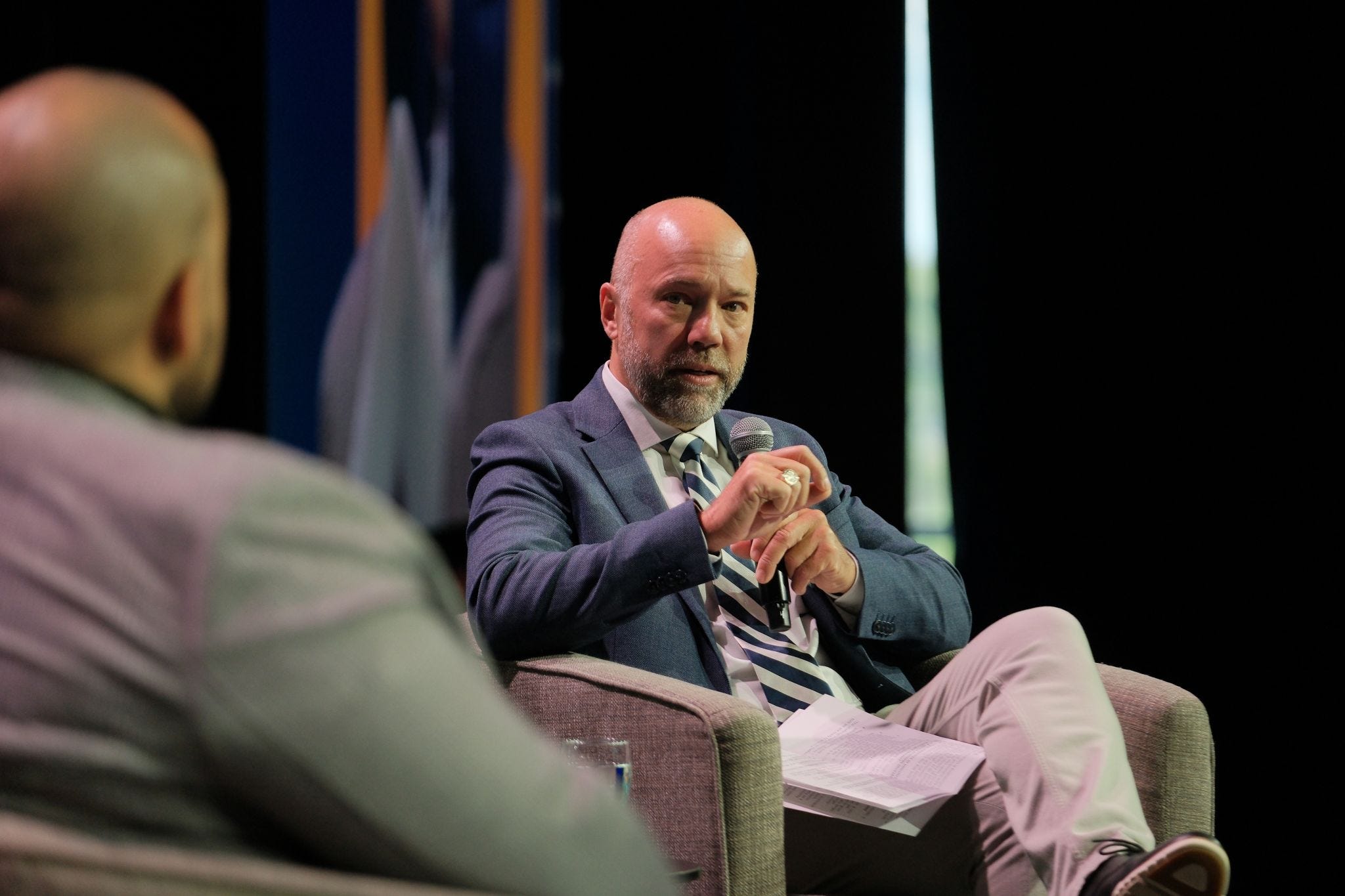
Mayor Fillmore speaking at a Federation of Canadian Municipalities panel on municipal infrastructure in June 2026. Photo credit: Federation of Canadian Municipalities
I’m in the middle of renovating my home right now. And like most home renovations, the list of things I’d like to do is longer than the list of things I can actually afford to do at one time.
Some things need to be fixed. Some would make the house function better. And there are plenty of things that would simply be nice to have.
They may all be good ideas. But time, money, and capacity are limited. So I have to make choices.
What needs to happen now? What can wait? What can I afford? And where will the investment make the biggest difference?
Those aren’t necessarily easy decisions. But they’re necessary.
Running a municipality is obviously much more complicated than renovating a house. But the basic principle is the same.
Our region has no shortage of worthwhile projects. We need infrastructure to unlock new housing. We need better transportation options to move more people around our growing region. Roads, bridges, and other existing infrastructure need to be repaired and replaced. Communities need recreation facilities, sidewalks, parks, and other public spaces.
These are all legitimate needs. But we don’t have unlimited money or unlimited capacity to build.
The hardest question isn’t whether a project is a good idea.
Most of them probably are.
The harder question is whether it’s more important than everything else competing for the same limited resources.
That’s what a Capital Plan is supposed to do. It turns a long list of worthwhile projects into a clear plan for what gets built, when it gets built, and why.
This is where the Auditor General’s findings on our capital budgeting process should concern us.
The Capital Budget Audit released this past June found weaknesses in how HRM evaluates projects, compares priorities across the organization, and connects that work to the projects ultimately recommended to Regional Council.
Simply put: Council should be able to understand why one project is recommended ahead of another. Right now, that connection isn’t clear enough.
If we’re being asked to approve a major investment, we should know how it was evaluated, what other priorities it was compared against, and why it needs to happen now instead of another worthy project. Because a long list of worthwhile projects isn’t the same thing as a plan. And if everything is a priority, then nothing is a priority.
The Auditor General found that the connections between project evaluation, prioritization, and recommendation to Council were not always clear or well documented.
That matters. When Council is making decisions involving billions of dollars in public investment, neither councillors nor taxpayers should have to take it on faith that the projects in front of us are the right priorities.
We should be able to show our work.
Because the consequences of getting those choices wrong are real.
Infrastructure needed to unlock new housing could be delayed. Critical transportation projects could be pushed back. Aging municipal assets could sit on the list for another year while risks and costs continue to grow.
And ultimately, residents pay the price.
That’s why prioritization isn’t just bureaucratic language. It’s about making sure taxpayer dollars are directed where they will have the greatest impact, and that there is a clear, defensible reason behind every major investment decision.
Getting these decisions right has always mattered. But right now, the stakes are getting higher.
Halifax is entering a generational period of investment. As Canada’s Defence City, we are preparing for major new defence-related activity - from shipbuilding and ocean technology to major employers expanding their operations - that has the potential to bring new jobs, new businesses, and thousands of new residents to our region.
That is an extraordinary opportunity. But it will also create new demands.
More people will need more homes. They’ll need ways to get to work. New communities will require roads, transit, water, wastewater, and other infrastructure - all while we continue investing in the communities we already have.
In other words, the list of worthwhile projects is about to get even longer.
We cannot meet this once-in-a-generation opportunity with weaknesses in the system we use to decide what gets built first.
If Halifax is going to be ready for the future, City Hall needs to get much better at making those choices.
The Auditor General made nine recommendations to strengthen HRM’s capital budgeting process, and the municipal administration has accepted all of them. I’ve listed them at the bottom of this article.
In the coming weeks, the administration will present its Capital Budget Audit Action Plan to the Audit and Finance Standing Committee outlining how those recommendations will be implemented.
Accepting the recommendations was the first step. Now, we need to see the plan to fix the problems.
The Action Plan needs to address the nine specific recommendations identified by the Auditor General. For each recommendation, I expect to see:
a single accountable owner from City Hall administration;
a comprehensive description of actions underway or to be undertaken;
a target completion date and interim milestones; and
the criteria against which completion will be measured.
I also expect to see how the administration plans to establish consistent capital budgeting procedures across business units; standard procedures and minimum requirements for preparing cost estimates; and documented guidance connecting project evaluation to corporate-level prioritization.
I don’t expect the Action Plan to fix every issue immediately. But I do expect a clear and accountable plan to address these critical issues before we start developing the 2027/28 municipal budget later this year.
If the Action Plan does not give Council the answers we need, I’ll be prepared to ask the Audit and Finance Standing Committee to provide additional direction to the administration and require stronger reporting requirements to make sure these issues are addressed with the urgency this moment demands.
Because accepting an audit recommendation isn’t the finish line. The test is whether we actually change how we do things.
Halifax’s future won’t be determined simply by how much we build. It will be determined by whether we build the right things, at the right time, for the right reasons.
Residents deserve to understand how those decisions are made - and to have confidence that we’re getting them right.
We can’t do everything at once. But we can get much better at deciding what comes first.
Andy Fillmore is an urban planner and Mayor of Halifax. Before entering politics, he spent roughly two decades working on urban planning, infrastructure, and city-building projects across North America - including Boston’s Big Dig and Halifax’s HRM by Design plan. He can be reached at mayor@halifax.ca.
The Auditor General’s Recommendations
The Auditor General made nine recommendations to strengthen HRM’s capital budgeting process. Municipal administration accepted all nine.
Recommendation 1: Clearly define roles and responsibilities
HRM management should ensure key roles and responsibilities are clearly defined in its capital budgeting governance structure.
Administration’s response: Accepted. Administration says an updated capital budgeting governance structure has been completed, including a new Treasury Board Terms of Reference introduced to the Senior Leadership Team in July 2025.
Recommendation 2: Strengthen direction and oversight
HRM management should ensure the governance structure clearly provides direction and oversight to the corporate-wide capital budgeting process.
Administration’s response: Accepted. Administration committed to ensuring that strategic direction, financial constraints, and key trade-offs informing the Capital Plan are clearly communicated from Executive and Council to the Capital Working Group.
Recommendation 3: Clarify how projects are evaluated and prioritized
HRM management should review and update the Capital Prioritization Framework to clearly define the roles and responsibilities of everyone involved in evaluating and prioritizing projects.
Administration’s response: Accepted. Administration will add clearly defined roles, responsibilities, and participant accountabilities to the Capital Prioritization Framework as part of its annual review.
Recommendation 4: Establish standards for capital cost estimates
HRM management should develop and implement clear minimum requirements and guidance for preparing capital cost estimates.
Administration’s response: Accepted. Administration will establish minimum corporate standards for capital cost estimates, including a checklist applicable across asset groups, with additional industry-specific requirements developed by individual asset groups.
Recommendation 5: Require quality reviews of cost estimates
HRM management should establish formal quality review requirements to ensure capital cost estimates are reviewed and supported before projects are included in the Capital Plan.
Administration’s response: Accepted. Executive Directors will be responsible for ensuring appropriate quality reviews are completed before projects are submitted for prioritization and scheduling. Administration also identified improvements to supporting technology as important to strengthening the process.
Recommendation 6: Document the rationale behind project evaluations
HRM management should develop and implement minimum documentation requirements explaining the rationale supporting capital project evaluation results.
Administration’s response: Accepted. Project managers will be required to confirm consultation with appropriate stakeholders on project ratings and will have space to document additional information supporting those ratings.
Recommendation 7: Connect project evaluation to prioritization
HRM should clarify the purpose of the capital project evaluation process, including whether and how evaluation results are expected to inform corporate-level project prioritization and selection.
Administration’s response: Accepted. Administration will document how prioritized projects are subsequently scheduled for investment, taking into account factors such as sequencing, interdependencies, labour and funding constraints, and service or event scheduling.
Recommendation 8: Update the Capital Working Group’s Terms of Reference
HRM management should review and update the Capital Working Group’s Terms of Reference and establish a periodic review process.
Administration’s response: Accepted. Administration will update the Terms of Reference and establish a regular review cycle to ensure they remain relevant and clear.
Recommendation 9: Keep formal records of Capital Working Group meetings
HRM management should maintain formal records of Capital Working Group meetings, including key discussions, decisions, and action items, and distribute meeting notes in a timely manner.
Administration’s response: Accepted. Administration says meeting presentations, committee emails, and Teams posts were used during the most recent budget cycle and plans to make greater use of Teams and AI technology to record committee meetings.